

Subhadip Roy Chowdhury
Subhodip’s Journey
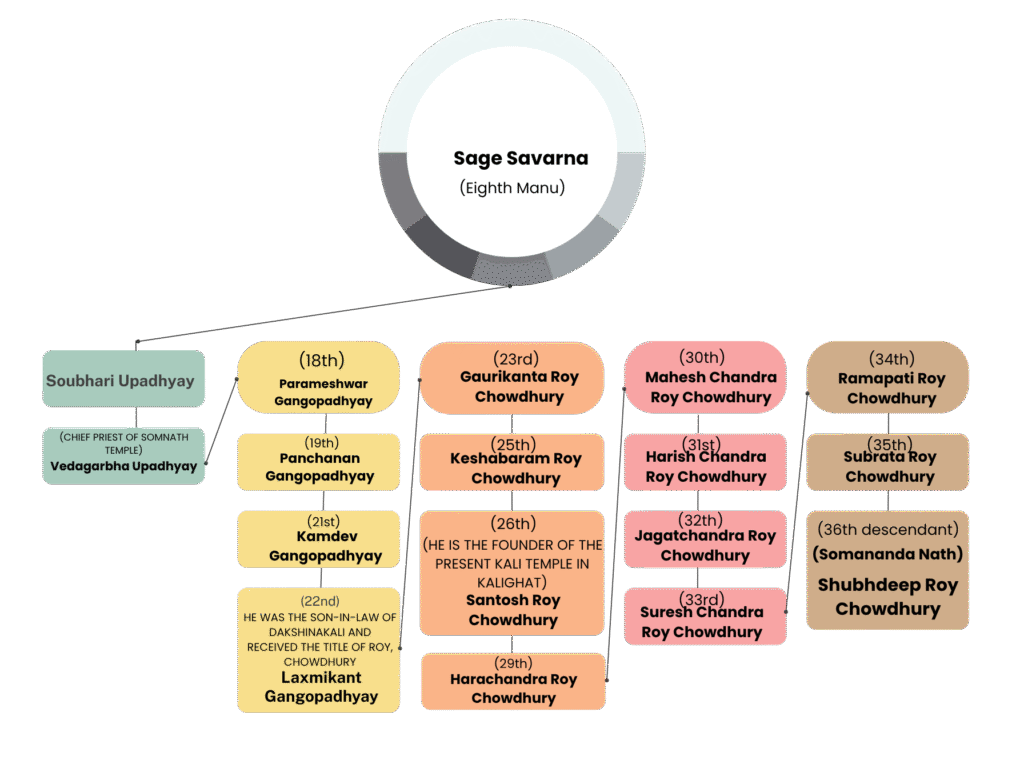
Subhadip Roy Chowdhury, born into the illustrious and aristocratic Sabarna Roy Chowdhury family of Kolkata, traces his lineage to Jagatchandra Roy Chowdhury of the family’s historic Chandi Bari. The ancient Maa Chandi Puja of this lineage carries with it a fascinating history.
It is said that Mahesh Chandra Roy Chowdhury, a great Matri Sadhak (Mother worshipper) from the same lineage as Santosh Roy Chowdhury, the founder of the Kalighat Kali Temple, once discovered a sacred eight-metal urn (ashtadhatu kalash) in a pond near his residence, following divine guidance. At the command of the Goddess, he consecrated this urn as an embodiment of Maa Chandi. That sacred pond is still known today as Chandi Pukur. The ancient urn is adorned with a Banarasi sari, a vermillion-marked coconut (shish-dab), silver eyes, golden nose ring, family ornaments, and a crown placed atop.

Although daily worship continues at the family’s residence throughout the year, during the bright lunar phase (Shukla Paksha) of the month of Agrahayan, the family celebrates Ashtami, Navami, and Dashami by creating a new image of the Goddess and holding grand festivities, accompanied by a large fair.
According to legend, when Mahesh Chandra began constructing a temple for the Goddess Maheshwari Chandi by cutting down an ancient banyan tree, he passed away shortly thereafter. His son, Harish Chandra Roy Chowdhury, completed his father’s unfinished work. In earlier times, the ritual included buffalo sacrifices—often requiring fifty or sixty strokes of the sword—and ascetic blacksmiths (Sannyasi Kamars) would perform the offering. The entire village participated, chasing the buffalo until it was exhausted and then offering it at the altar. It was Nandadulal Roy Chowdhury, a later descendant, who finally abolished this tradition of animal sacrifice.
The family of Shubhdeep has long been devoted to Tantric worship. His grandfather, Shantichandra Roy Chowdhury, was a revered Chandi Sadhak, with disciples from across India. Their kuladevi (family deity) is none other than Dakshinakali of Kalighat. From childhood, Subhadip sang devotional songs to the Mother and visited various temples. While studying at Ballygunge Rashtriya Vidyalaya, he underwent his Upanayan (sacred thread initiation) ceremony, after which he met a saint named Yoginath Prabhu near his home. Yoginath first initiated him with the Shiva mantra, telling him that one day his true mantra-guru would arrive.
During his school years, Subhadip received initiation into his Ishta mantra (personal deity’s mantra), marking the beginning of his spiritual journey. His mother, Dalia Roy Chowdhury, a devoted worshipper of Mahamaya Bagaladevī, was a guiding force who gently led him toward the Tantric path.
During his higher secondary studies, Subhadip met Kulabhadutacharya Srimat Bishweshwarananda Nath, who initiated him into Tantra and taught him the disciplines of Shmashan Sadhana, Chita Sadhana, and other esoteric practices. It was he who gave Subhadip his spiritual name — Somananda Nath.
However, even after receiving Tantric initiation, Somananda’s heart remained deeply drawn to the sacred feet of Sadhak Basudev Paramahamsa. While studying at Scottish Church College, he often visited the Kalighat Mahashmashan, meditating there for hours. Whenever time allowed, he would walk from his college to the ancestral house of Swami Vivekananda, his spiritual inspiration, and meditate in the temple of Lord Shiva located there.
Despite progressing deeply in Tantra, Somananda never ceased searching for Sadhak Basudev. Knowing that the saint had spent his final days at Kankulia and had earlier lived in Dhakuria’s Mukherjee Para, Somananda often visited those areas seeking traces of him. He also journeyed to the Kashimitra cremation ground, where Basudev Paramahamsa had once performed the sacred Panchamundi Sadhana. There, Somananda met many of Basudev’s close devotees and continued his search across Kolkata and Bengal, seeking the presence of his spiritual father.
